
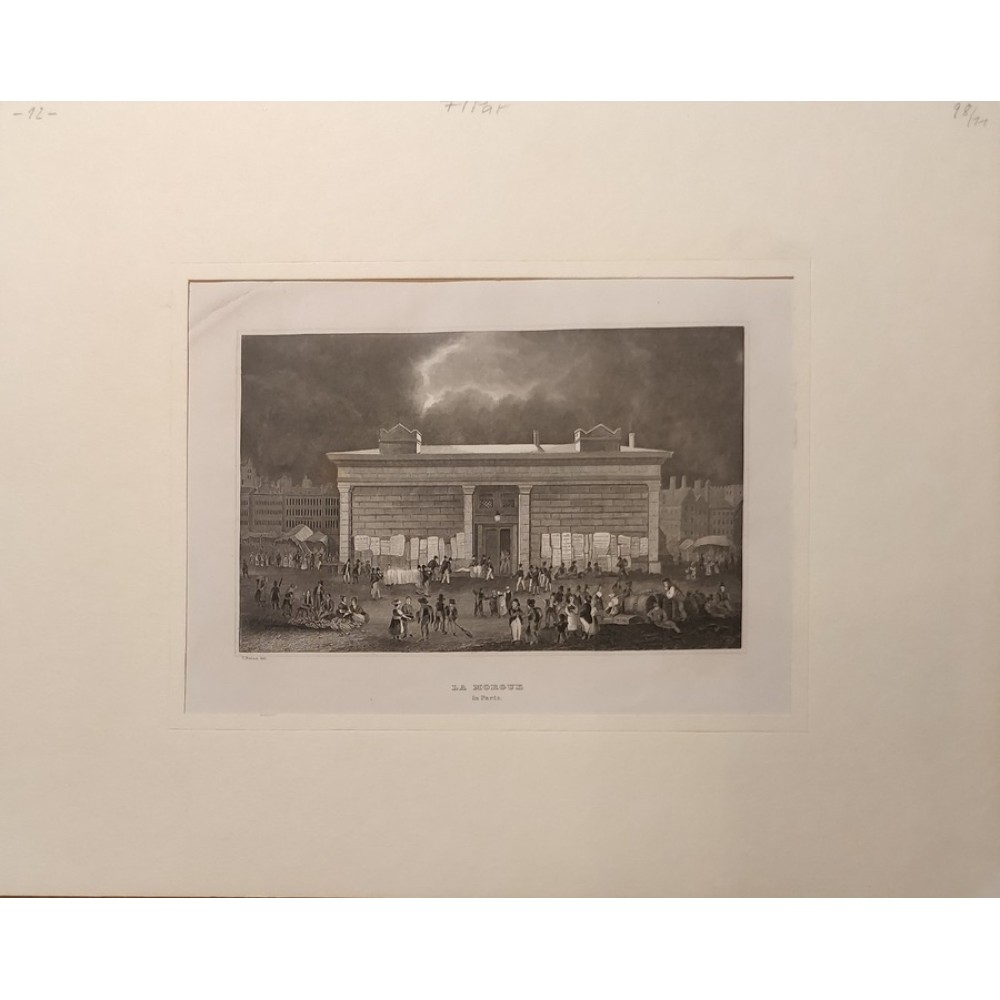
Parisian Morgue – a popular destination for Parisian walks in the 19th century.
An authentic antique engraving from 1844, an impression from a steel engraved plate under the direction of Charles Heath.
Image size (cm): 11.0 x 15.5
Paper size (cm): 15.5 x 22.5
Mat size: 30 x 24 cm
Original title: LA MORGUE in Paris
Engraver: Albert Henry Payne
Language: German
Engraving from the Meyers "Meyers Universum" ("Meyer's Universe or Illustrations and Descriptions of Natural and Artistic Wonders of the World") publication, published by the “Bibliographical Institute.” The edition was published in Hildburghausen, Germany. Meyers Universum was published from 1833 to 1861, with a total of 17 editions in 12 languages.
Publisher: Carl Joseph Meyer (1796-1856)
The image is in excellent condition, but there is a tear in the upper corner that can be concealed by the mat.
This engraving was printed over 170 years ago from a steel plate under the direction of Charles Heath (1785-1848), a renowned publisher and the first to use this method for creating engraved illustrations, for the series "Paris and its Surroundings."
Indeed, people who were unlucky enough to be born in the 19th century had few forms of entertainment. Some might argue that they at least had fresh air and ecologically clean turnips. But what good is that Even if you live to a ripe old age with such an ecological lifestyle, you still won't have your favorite television series! Unless you live long enough to see the documentary "Arrival of a Train at La Ciotat Station" – though that’s not guaranteed.
In general, entertainment was scarce. Therefore, it is not surprising that one of the main attractions in 19th-century Paris became a public city morgue.
At the beginning of the century, the morgue was located in a small, dark room in the Conciergerie prison. In 1804, it moved to its own building near the Pont Saint-Michel bridge. And finally, during the redevelopment of Paris by Baron Haussmann, the morgue triumphantly settled into a large and ornate building behind Notre Dame Cathedral.
The moves to increasingly larger and more accessible spaces for Parisians were linked to the growing popularity of the morgue. The fact is that it was open to the public. And bodies of unidentified deceased individuals were displayed there. This was formally done for practical purposes – so that Parisians could identify the dead. In reality, however, the morgue became an attraction for residents of Paris.
For example, on a weekend morning, a Parisian would read about another body being fished out of the Seine. "Children, I know where we're going today!" he would tell his offspring. And the whole family would go to gawk at the naked bodies in the morgue and the clothes hanging nearby in which the deceased had been found. (Small pieces of fabric were left on the bodies as a matter of propriety.) It was thrilling, exciting, and nerve-wracking.
Before you start calling Parisians of the 19th century barbarians, ask yourself: what would *you* do in their place without "Game of Thrones" How would you entertain your children on weekends without a tablet full of games That’s the truth.
Sometimes there were no unidentified bodies in the Seine or in the city, and the marble tables behind glass were empty. But the public still flocked to the morgue, which was open seven days a week: just in case someone *did* get carried out.
Several times throughout its century-long history, the morgue experienced veritable sieges by those eager to witness particularly curious "exhibits." For example, a total of 400,000 people came to view the body of a young woman murdered by her lover and fished out of the Seine in 1876.
The discovery of the body of a 4-year-old girl also soon sparked similar excitement. The morgue workers even inexplicably placed her remains on a chair instead of laying them on a table, adding to the spectacle's horror.
Memories of the Parisian Morgue were also left by Mark Twain in his travel notes "The Innocents Abroad" (1869). We pass the word to the master and eyewitness:
“Then we went to the morgue, that grim resort of the dead, bearing with them the frightful secret of their demise. We stopped before the grating and looked into the room where the garments of the deceased were hung—soaking wet, coarse blouses, elegant women’s and children’s dresses, slashed and stabbed costly suits in red stains, a crumpled, blood-stained hat. Upon an inclined stone slab lay a drowned man—naked, swollen, livid; in the fist, which death had petrified so that it cannot be opened, was clutched a broken twig—a mute testimony of the last desperate effort to save a doomed life.”
Only at the beginning of the 20th century did voices begin to question whether it was ethical to display victims of crimes or tragic accidents for public viewing. As humanism spread, these voices grew louder, gradually merging into a chorus. As a result, the Parisian Morgue was closed in 1907 on ethical grounds. And then cinema arrived – albeit silent.
Steel engraving is a type of engraving where printing is done from a steel plate (metal plates are traditionally called "plates" by analogy with the oldest form of engraving - woodcut). The image is applied to the steel plate using a burin made of a harder grade of steel; steel engraving is a variety of intaglio engraving. Steel engraving gained popularity in reproductive graphics in the 19th century, replacing the widespread use of copper engraving, previously used for creating illustrations.
The advantage of steel engraving was its greater hardness and therefore greater durability compared to copper. Steel engraving was invented by the American inventor Jacob Perkins (1766-1849) for printing banknotes. When Perkins moved to London in 1818, his technique was adapted in 1820 by Charles Warren and Charles Heath (1785-1848) for printing Thomas Campbell's "Pleasures of Hope."
From the 1820s, steel engraving replaced copper in book publishing and throughout the 19th century competed with woodcut and lithography as the main technique for printing illustrations.
The reverse is clean.
Parisian morgue on the Notre-Dame embankment, Paris.
- Product Code: 9997
- Availability: In Stock
-
$0.00