
“A Harlot’s Progress” is a series of 6 paintings and engravings by William Hogarth. The series depicts the story of a young woman, Moll (Mary) Hackabout, who arrives in London from the countryside and becomes a prostitute.
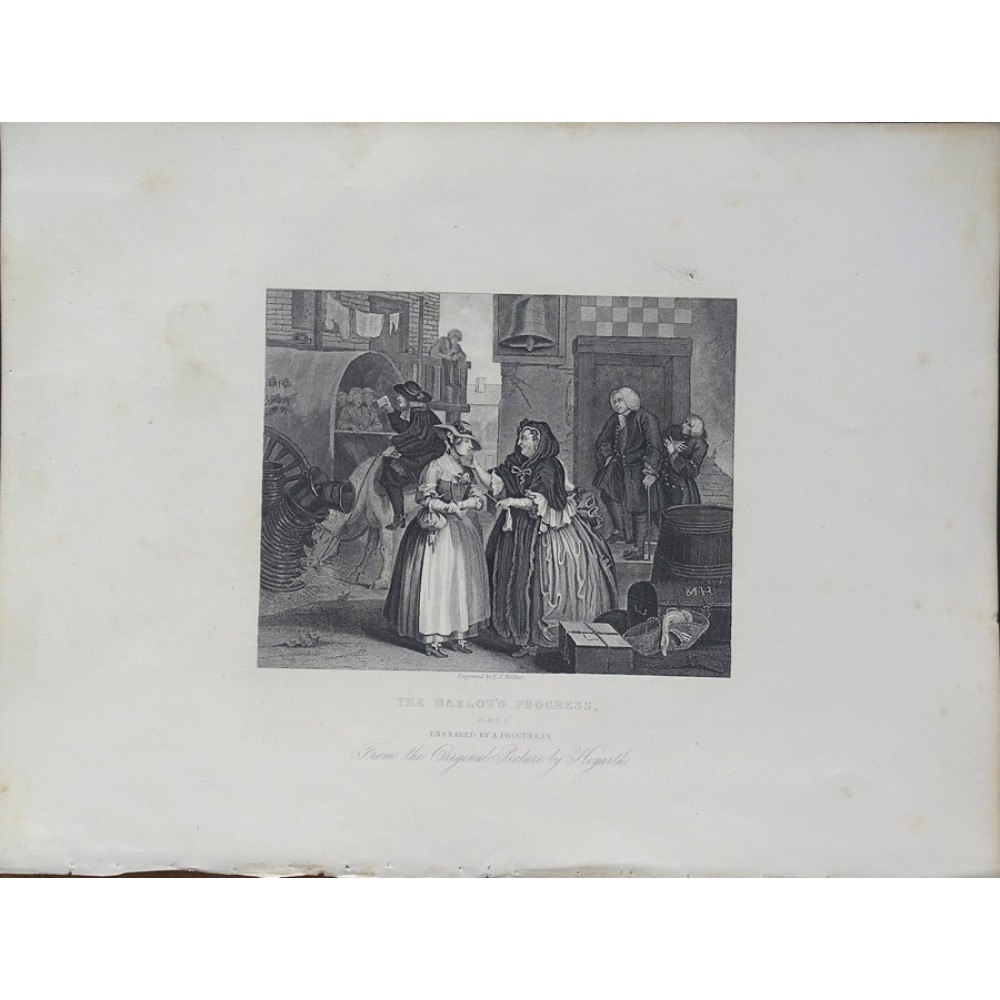
1. In the Snare of a Bawd.
The painting is filled with wordplay and double meanings. The inn sign (Bell Inn) with its bell can be related to Belle (Fr. Beauty), a young woman recently arrived from the countryside, and partially repeats the silhouettes of Moll and Needham. The scissors and pin cushion hanging on Moll’s arm indicate she is a seamstress; the dead goose symbolizes Moll's naivete. The falling pile of pots and pans symbolizes Moll's "fall."
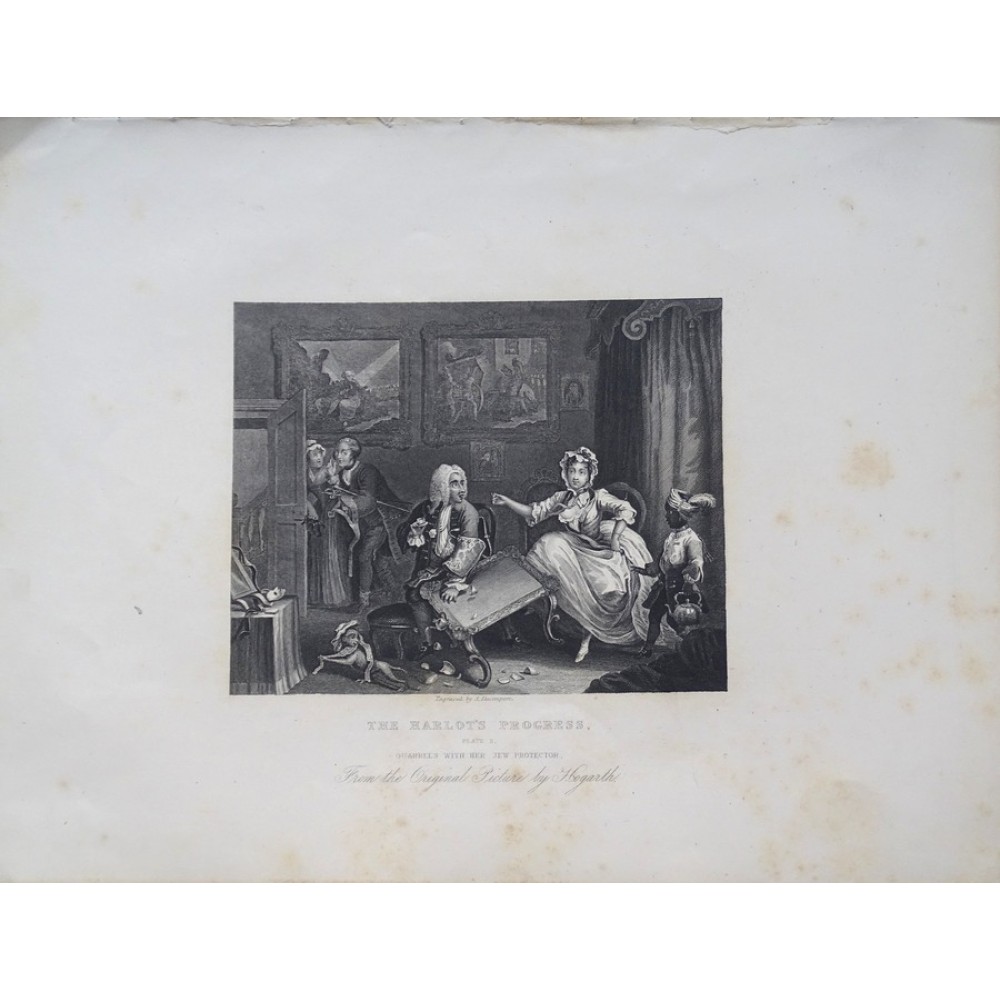
2. Quarrel with a Jewish Patron
Moll is a kept woman, the mistress of a wealthy Jewish merchant. She has a rich wardrobe and servants, keeps an indentured boy from the West Indies and a monkey. The boy, young maidservant, and the monkey are likely provided by her wealthy patron. Cosmetic jars, a masquerade mask, her apartment is decorated with paintings illustrating her contradictory and dubious position. She overturns the table to distract the merchant while a servant helps another lover escape.
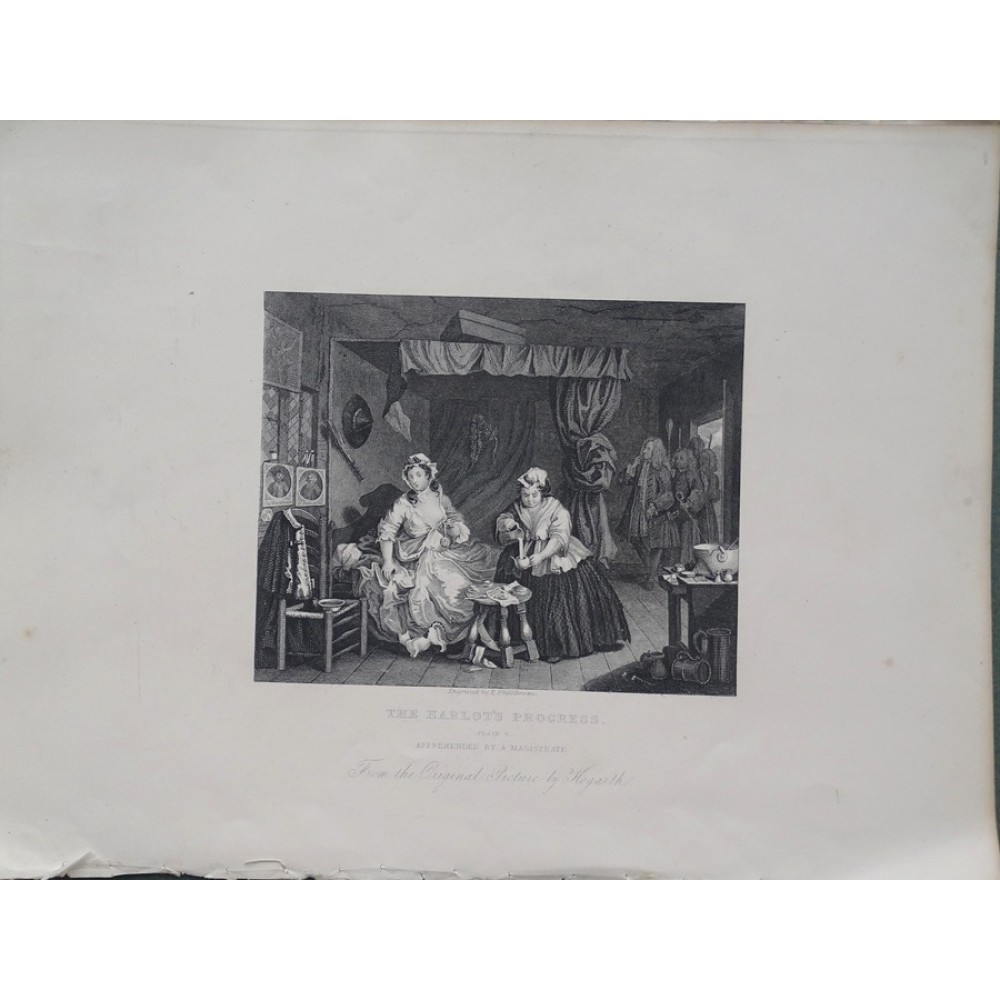
3. Arrest
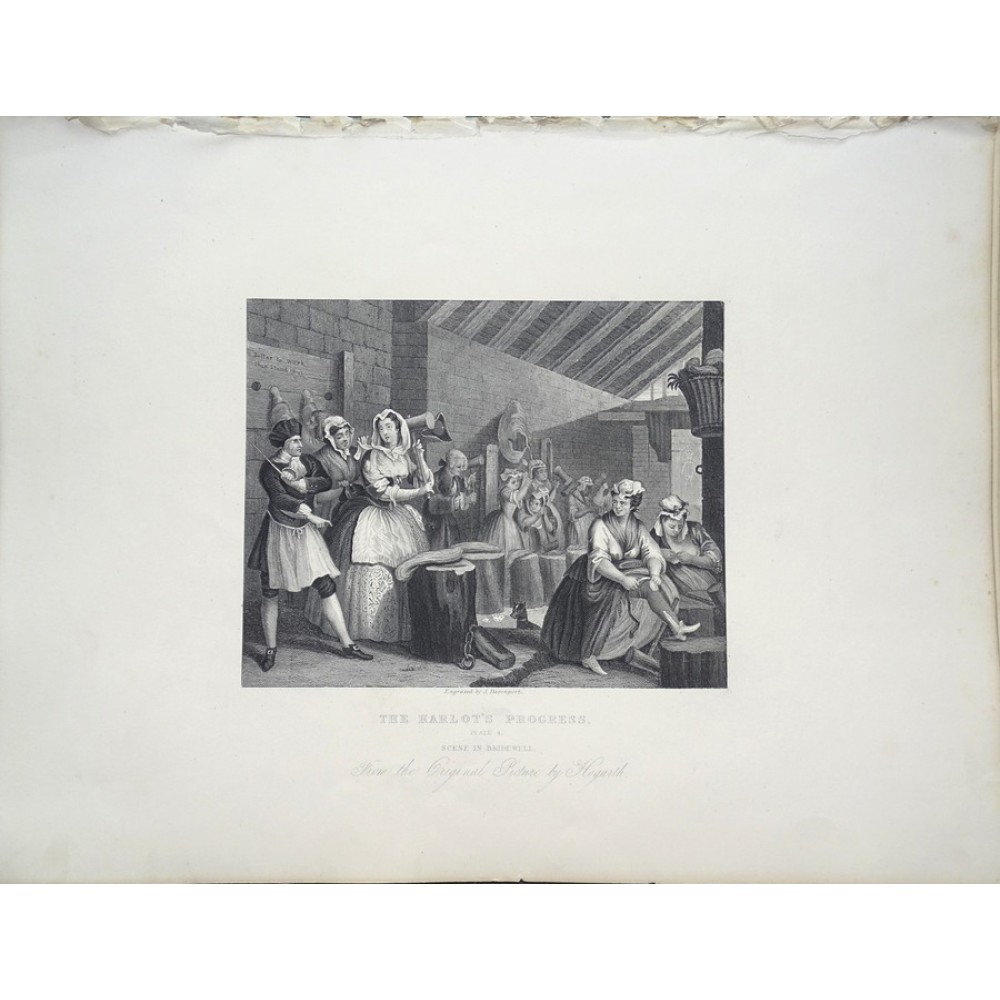
4. A Scene in Bridewell
Moll is imprisoned in Bridewell. She spins spools for the hangman’s noose while the jailer threatens and forces her to work. The serving woman smiles at the fact that the jailor's wife is taking Moll’s dress, and the servant seems to be wearing Moll’s boots. The prisoners proceed from left to right in order of decreasing wealth: a man who brought his dog—a cheat whose extra card fell out; a woman; a child, possibly suffering from Down syndrome, and a pregnant African woman who may have become pregnant while already subject to legal proceedings, as pregnant women could not be executed or transported. A pillory bears the inscription: "Better to work than so to stand." The man suffering at the pillory has evidently refused to work.
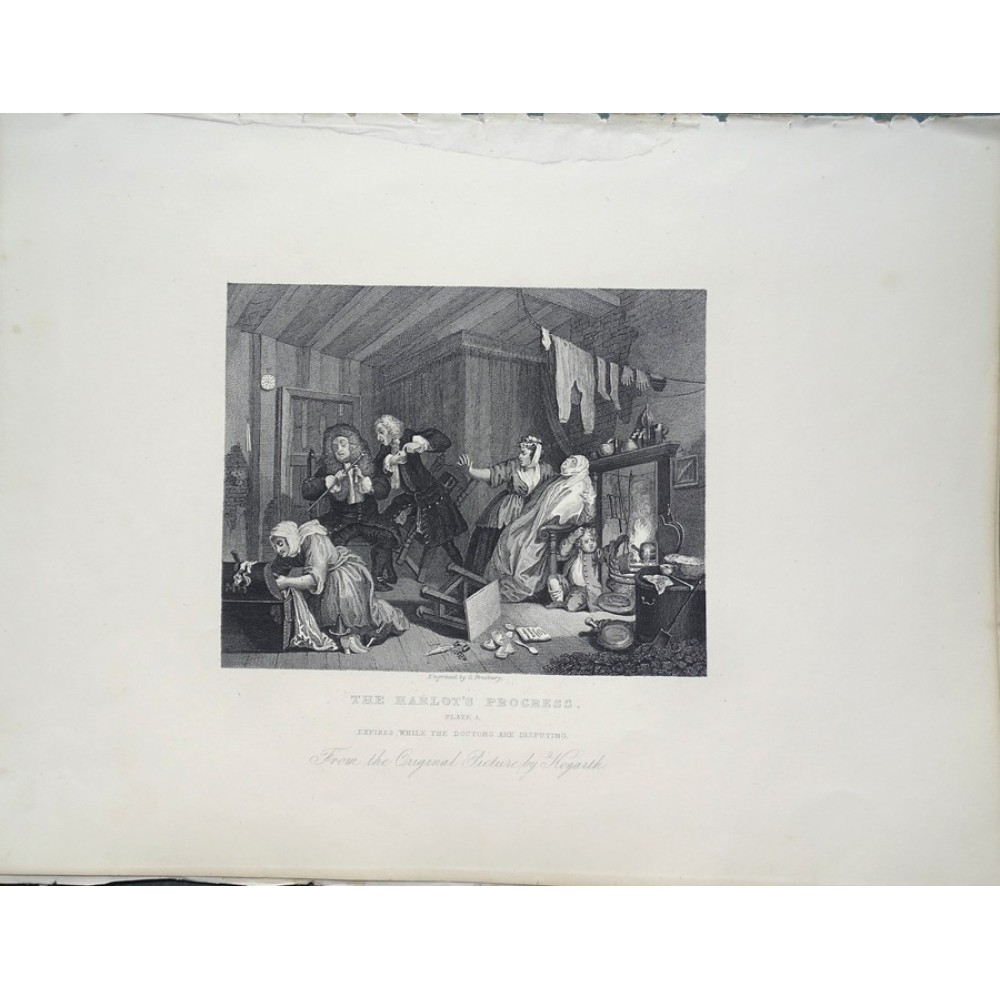
5. Dying While Doctors Dispute
Moll is now dying of syphilis. Doctor Richard Rock is on the left and Doctor Jean Mizobin are on the right, arguing about their medical methods. A woman, possibly Moll’s bawd and perhaps the homeowner, examines Moll's belongings to select what she can use, while Moll’s maid attempts to stop the looting. Moll’s son sits by the fire, likely infected with his mother’s disease. He picks lice from his hair. Bottles of pain relievers lie broken on the floor. Clothing pulls Moll toward the floor as if ghosts are dragging her into the afterlife.
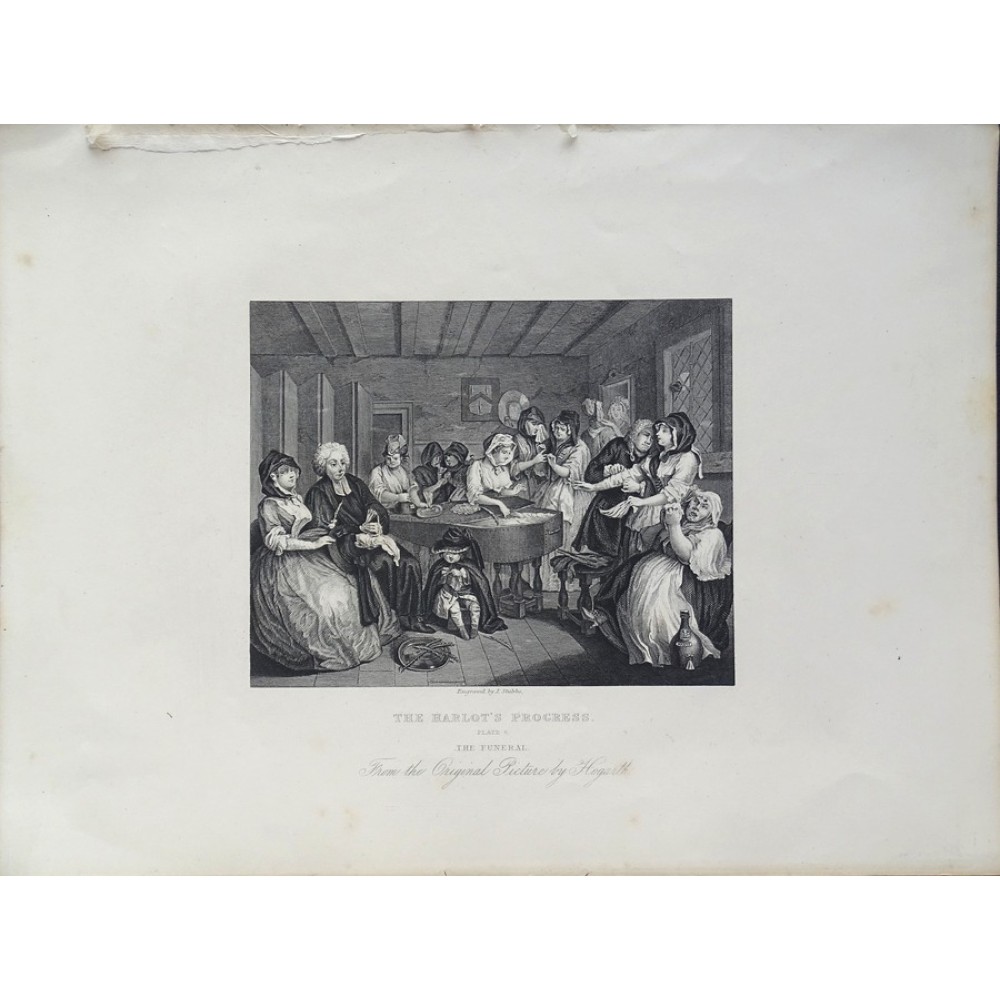
6. Funeral
In the final scene, Moll is dead. The inscription on the lid of the coffin states that she died at the age of 23 on September 2, 1731. The pastor spills his brandy as he holds a hand under the skirt of the girl next to him—she appears content. Moll’s son plays carelessly, while the drunken bawd (on the right) sincerely mourns as she watches her “charge” being used as a bar counter; her bottle of brandy leers horribly. A mourning prostitute steals a handkerchief from her comforter's nose. Another shows her diseased finger to a colleague, while another woman primps at a mirror even though a syphilitic ulcer is visible on her forehead. Moll’s son plays carelessly under his mother’s body, unable to understand what has happened, figuratively doomed to death. The house in which the coffin with Moll's body stands has an ironic coat of arms on the wall depicting a chevron with three bugle horns, symbolizing the pastor’s “spilling,” spilled brandy, and Moll’s last breath.
In modern art, there are many artists who resort to humor in their work. But how many humorous paintings can be remembered from the dawn of classical painting One of the brightest satirical painters is English artist and engraver William Hogarth. He confirms by personal example the saying: humor comes from poverty.
Hogarth’s world is terrible, lively, noisy, horrifying, and captivating, a world that leaves no one indifferent. The artist's direct involvement in his contemporary life still captivates today, despite a two-hundred-year gap in time.
Young English capitalism of that time resembles our time and our vices. Hogarth’s works are still modern and instructive.
Hogarth’s series and genre works are unique material for studying the customs and manners of the 18th century. It is a kind of painted novel, embodied in several or even one work. The artist opened up to his contemporaries a world that had previously not interested high art—London streets, gambling houses and brothels, bars, prisons. Refined feelings and amenities were contrasted by Hogarth with a terrible and repulsive world. He saw murderers in elegant gentlemen and vulgar harlots in fashionable ladies, instead of salon entertainments he showed nocturnal brawls, unbridled debauchery, and gambling. His heroes are bawds, prostitutes, misers, thieves, tricksters, and murderers. The titles of the series speak for themselves: “The Harlot’s Progress,” “The Rake's Progress,” "A Modele Marriage," "Four Times of Day," "Industry and Idleness," "Four Stages of Cruelty."
It is also interesting that some researchers consider Hogarth to be a pioneer of what is now the familiar genre of comics.
William Hogarth 1833 Mixed Lot of 10 Steel Engravings. Book Plates
- Product Code: 9343
- Availability: In Stock
-
$6,000.00