
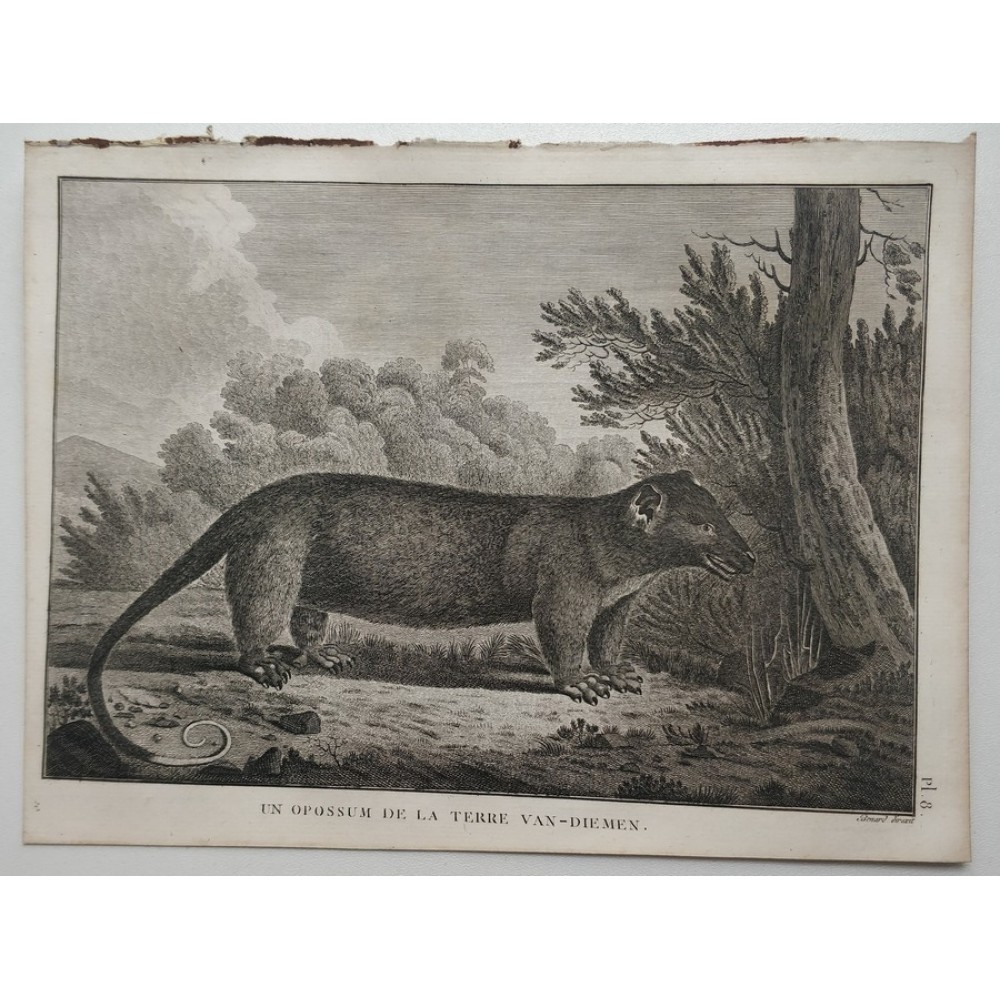
ANTIQUE COPPER ENGRAVED PLATE OF A TASMANIAN DEVIL 1785
Condition:
--not specified
Ended:Jul 12, 2022 , 7:03AM
Winning bid:
US $24.50
TASMANIA TASMANIAN DEVIL AUSTRALIA 1785 COOK/HAWKESWORTH ANTIQUE ORIGINAL PLATE
Description
Un Opossum de la Terre Van-Diemen.
Description: Striking and highly detailed interesting 1785 copper engraved plate depicting a Tasmanian Devil.
The first reported sighting of Tasmania by a European was on 24 November 1642 by Dutch explorer Abel Tasman, who landed at today's Blackman Bay. More than a century later, in 1772, a French expedition led by Marc-Joseph Marion du Fresne landed at (nearby but different) Blackmans Bay, and the following year Tobias Furneaux became the first Englishman to land in Tasmania when he arrived at Adventure Bay, which he named after his ship HMS Adventure. Captain James Cook also landed at Adventure Bay in 1777. Matthew Flinders and George Bass sailed through Bass Strait in 1798-99, determining for the first time that Tasmania was an island.
Sealers and whalers based themselves on Tasmania's islands from 1798, and in August 1803 New South Wales Governor Philip King sent Lieutenant John Bowen to establish a small military outpost on the eastern shore of the Derwent River in order to forestall any claims to the island by French explorers who had been exploring the southern Australian coastline. Bowen, who led a party of 49, including 21 male and three female convicts, named the camp Risdon.
Several months later a second settlement was established by Captain David Collins, with 308 convicts, 5 kilometres (3.1 mi) to the south in Sullivans Cove on the western side of the Derwent, where fresh water was more plentiful. The latter settlement became known as Hobart Town or Hobarton, later shortened to Hobart, after the British Colonial Secretary of the time, Lord Hobart. The settlement at Risdon was later abandoned. Left on their own without further supplies, the Sullivans Cove settlement suffered severe food shortages and by 1806 its inhabitants were starving, with many resorting to scraping seaweed off rocks and scavenging washed-up whale blubber from the shore to survive.
The plate was engraved by Robert Bénard.
Cook's Third Voyage.
James Cook's third and final voyage (12 July 1776 - 4 October 1780) took the route from Plymouth via Cape Town and Tenerife to New Zealand and the Hawaiian Islands, and along the North American coast to the Bering Strait.
Its ostensible purpose was to return Omai, a young man from Raiatea, to his homeland, but the Admiralty used this as a cover for their plan to send Cook on a voyage to discover the Northwest Passage. HMS Resolution, to be commanded by Cook, and HMS Discovery, commanded by Charles Clerke, were prepared for the voyage which started from Plymouth in 1776.
Omai was returned to his homeland and the ships sailed onwards, encountering the Hawaiian Archipelago, before reaching the Pacific coast of North America. The two charted the west coast of the continent and passed through the Bering Strait when they were stopped by ice from sailing either east or west. The vessels returned to the Pacific and called briefly at the Aleutians before retiring towards Hawaii for the winter.
At Kealakekua Bay, a number of quarrels broke out between the Europeans and Hawaiians culminating in Cook's death in a violent exchange on 14 February 1779. The command of the expedition was assumed by Charles Clerke who tried in vain to find the passage before his own death. Under the command of John Gore the crews returned to a subdued welcome in London in October 1780.
Source: John HAWKESWORTH & James COOK. Troisième voyage de Cook, ou Voyage à l'océan Pacifique, ordonné par le roi d'Angleterre, pour faire des découuertes dans l'hémisphère nord, pour déterminer la position & l'étendue de la côte ouest de l'Amérique septentrionale, sa distance de l'Asie, & résoudre la question du passage au Nord, exécuté sous la direction des Capitaines Cook, Clerke et Gore sur les vaisseaux la résolution et la découuerte en 1776, 1777, 1778, 1779 & 1780 traduit de l'anglois par M. D********. A Paris: Hôtel de Thou, rue des Poitevins, M. DCC. LXXXV. (1785).
Date: 1785 ( undated )
Dimension: Paper size approx.: cm 25,1 x 18,9
Condition: Very strong and dark impression on good paper. Paper with chains. Map uncolored. Small margin to the top. Short lower margin. Quite right lateral margin missing. Short left lateral margin. Small foxing and browning. Conditions are as you can see in the images.
Mapmakers: Robert Bénard (1734 - c. 1785) was a French engraver. Born in Paris, Bénard is best known for supplying a significant number of plates (at least 1,800) for the Encyclopédie published by Diderot and Alembert. He also is remembered for his work with the Académie des Sciences, most notably the Descriptions des Arts et Métiers.
John Hawkesworth (c. 1715 - November 16, 1773) was an English born writer and editor born London. Hawkesworth, who is said to have been self educated, succeeded Samuel Johnson as the parliamentary debate compiler for "Gentleman's Magazine". He was a deeply religious and moral map who brilliant defense of morality earned him an LL. D degree from the Archbishop of Canterbury. Hawkesworth went on to publish a series of scholarly books and essays including a 12 volume edition of Jonathan Swift's work. In 1772 Hawkesworth was commissioned by the Admiralty to compile and edit James Cook's journals. The resultant work An Account of the Voyages undertaken ... for making discoveries in the Southern Hemisphere was one of the first ethnographic account of the South Seas and was widely published in England and abroad. Though highly influential, Hawkesworth's work received heavy criticism from scholars who claim that he liberally altered much of the text in the name of morality.
Captain James Cook (7 November 1728 - 14 February 1779) is a seminal figure in the history of cartography for which we can offer only a cursory treatment here. Cook began sailing as a teenager in the British Merchant Navy before joining the Royal Navy in 1755. He was posted in America for a time where he worked Samuel Holland, William Bligh, and others in the mapping of the St. Lawrence River and Newfoundland. In 1766 Cook was commissioned to explore the Pacific and given a Captaincy with command of the Endeavour. What followed were three historic voyages of discovery, the highlights of which include the first European contact with eastern Australia, the discovery of the Hawaiian Islands (among many other Polynesian groups), the first circumnavigation of New Zealand, some of the first sightings of Antarctica, the first accurate mapping of the Pacific Northwest, and ultimately his own untimely death at the hands of angry Hawaiians in 1779. The influence of Cook work on the mapping and exploration of the Pacific cannot be understated.
Название: Un Opossum De La Terre Van-Diemen
Гравюра была выгравирована Робертом Бенаром и была опубликована во французском издании 1785 года книги «Капитан Джеймс Кук и капитан Джеймс Кинг: Путешествие в Тихий океан.....» (Capt. James Cook & Capt. James King A Voyage to the Pacific Ocean. Undertaken, by the Command of his Majesty, for making Discoveries in the Northern Hemisphere. To determine The Position and Extent of the West Side of North America; its Distance from Asia; and the Practicability of a Northen Passage to Europe. Performed under the direction of Captains Cook, Clerke, and Gore, In His Majesty's Ships the Resolution and Discovery. In the Years 1776, 1777, 1778, 1779, and 1780. In Three Volumes. Vol. I and II written by James Cook, F.R.S. Vol. III by Captain James King, LL.D. and F.R.S. Paris, 1785.)
Tasmania Tasmanian Devil Australia 1785 Cook/hawkesworth Antique Original Plate
- Product Code: 10693
- Availability: In Stock
-
$24.50